The Huckleberry Haj

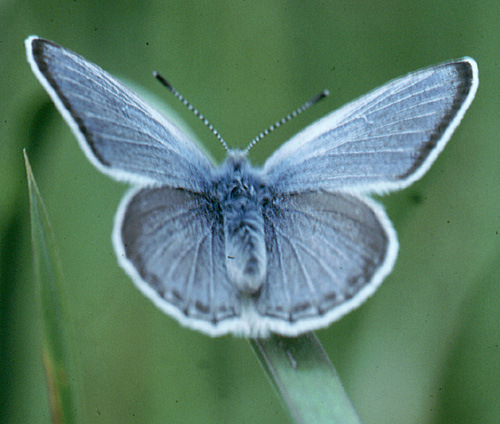
The butterflies were all around us.

Wave after wave, spasms of blue flowed in and out of the space between us like a shimmering, levitated river threading through the forest of high, silent pine. The brown dust of the road covered the waist-high berry bushes.

Yet, we couldn’t keep our eyes off the butterflies.

They were migrating through the Cascade mountains and we were there -- in the right place -- to not only see them, but feel them, to be enveloped in their flashing color. It was a surreal, perfect moment that could have easily been missed.  

A perfect place. A perfect moment.

We were there to pick the huckleberries.
The Berry


That first year, we had not gone where the park ranger told us to pick. Instead, we followed my sister Mindy, who led us off the main road, and then up another road. The weathered ruts had tortured the truck’s suspension, but yielded to a flat parking area surrounded by trees. Below the trees were the berry bushes, thriving in the light created by windfalls and clearings.

The huckleberry is similar to a wild blueberry, but with more tartness and flavor.  It grows wild in the Indian Haven and the forests on Mount Adams near Trout Lake, Ice Caves and Natural Bridges parks

In fact, if you drive along these roads in the Gifford Pinchot National Forest, there is a good chance that the underbrush flashing by your windows holds this natural treasure. Juice, purple and blue. In places you need only stop and walk 10 yards into the waist-high brush to see the dark spheres of sweetness.

So many pass this way without knowing what glory lies at their fingertips. If you only look. If you only stop and take the time to look, to pick, to savor.

The year of the butterflies was the first. Grace was still in diapers. Mindy showed us where to find the berries. Each year we returned. The Huckleberry Haj became the MUST moment of our year.

The butterflies painted this one place with magic blue only once, but they cemented in us a spiritual connection to the forest around us, to this time and this place. Like the annual Haj to the spiritual center of the Muslim world, this became an annual pilgrimage for my family. Each year we return to this place the pay homage to summer by gathering its fruits. This is the holy place of summer. The Huckleberry Haj is how we honor and remember.

My sister Mindy, my wife Amy, my mom, Alice, me and my daughters -- all of us out in the woods for hours on summer days. High on the mountain, it was cooler, quiet, save for the the wind swaying the lodgepole pine, the chatter of a jay, the scurrying of chipmunk or squirrel.

My mom has picked berries since she was a child. Her Swedish-born mother would send her into the New England woods with a pail and tell her not to return until is was full of blueberries.

When we moved west, we would go berry picking too -- to make jams and jellies.
Amy and Mindy were the most ardent berriers. Amy doesn’t like to return until we fill a Coleman cooler with berries. The two of them would pick and talk the hours away, following the berry deep into the forest.

The girls are better now, but in the early years would just fill their stomachs rather than the little plastic buckets tied on ropes around our waists or hung about their necks. Suspending the buckets allows you to pick with two hands. Yet for every plunk in the bucket, three more berries always went into Grace’s mouth.


When the girls got bored, it was my job to corral them and keep them occupied. To stay close so that Amy and Mindy and Mom could stay on the trail of the berry. Mom’s yellow Lab Wendy ran relay between the pickers and the dilettantes who meandered back to the truck for sandwiches and juice.

The Huckleberry Haj is our summer constant. Our annual rite taking us from Summer to Fall.

After the Wahkiakum County Fair and before school starts again, we come up here to capture the last fruit of summer. We store it away in little tupperware containers in the cooler. When we get them home, we freeze them. You can use them in muffins or other baking if you like, but best of all is to just pop them still frozen in your mouth. Summer candy, on the darkest, rainiest winter day.

We make this pilgrimage every year to pay homage to the sun and the good slow days before they slip away.

In the last few years, first Mom, and then Mindy, haven’t always made it up to pick with us.

Mom was diagnosed with lung cancer five years ago - it was in the Fall, when the days were growing shorter. It was Stage 1 - caught early on an x-ray looking for something else. She had a surgery to remove one lobe of her lung, then chemotherapy to eradicate any remaining cancer cells. The chemo was hard on Mom, but Mindy lived just a few blocks away. It was Mindy who was there to help her through the rough days.

It was Mindy who was diagnosed with stage 4 lung cancer almost exactly one year later. Even with chemotherapy, they told her she only had six months to live.

By Christmas - she was so sick and frail and in pain -- I did not think she would make it to the new year.

Miracles, sometimes, are just doctors and nurses just doing their job. Paying attention, making the right change at the right time, taking chances.. Chemotherapy is a science of trial and error. It takes a stubborn and determined patient. Mindy would not give up so easily. At times her husband drained a liter of fluid a day out of her lungs through a valve sewn into her side.

In early summer when her oldest son got married. Mindy was standing there in a gold dress, with long black hair, walking through the cherry blossoms, dancing in the sun.

We thought we had dodged another bullet. That, she, like Mom would now be OK.
We picked berries that summer -- something I thought would be impossible six months before.

Yet doesn’t the summer seem impossible in the dark days of winter. Hope is a dream of a path through the winter to the spring.

My mom’s cancer was caught early -- just a tiny shadow in a single lobe of one lung.
Mindy’s cancer was caught late -- spread throughout her body. Metastasis is a word that holds the appropriate malevolence. It is a diagnosis still whispered.

The cancer that both Mom and Mindy had was adenocarcinoma. It is the most common lung cancer contracted by people who never smoke. My aunt and cousin were also diagnosed with adenocarcinoma -- on the far side of the country -- about the same time.

Mindy’s was the most aggressive, it seemed.

So it seems there is some sort of genetic predisposition, but as far as I can tell, it is little understood. Mindy had never smoked, was young and otherwise healthy and active. Perhaps that is what helped Mindy get accepted into clinical trials at Oregon Health Science University for oral medications genetically matched to her tumors.  

Four days after she started taking the pills, she called me.

“I think this medicine is working,” she told me. “I’ve stopped coughing.”

The spasmodic cough was so agonizing it could silence a room. It was a hallmark of her malady.

“It can’t be,” I told her. “Nothing works that quickly.”

Yet, a few weeks later she was scheduled for a CT guided biopsy of the tumor in her lung. She lay on the table in the room waiting for the radiologist. There was activity in the control room, but no word to her. Finally, they told her - the tumors had shrunk so much, there was not enough there to take a sample. The tumors had shrunk by 85 percent.

She saw her youngest son graduate from high school that year.

Last year she was there with us, picking huckleberries, but Mom was worried.

The experimental drugs were miraculous, but not enduring. Her cancer was so aggressive that it mutated around the drugs. So her oncologists got her into another trial -- this one with no significant effect -- and then another trial with better results. She lost her glorious black hair. Rather than wear a wig in the hot summer of Eastern Oregon, she got a henna tattoo to decorate her bald head. Each drug that worked, worked a little less than the one before. She had good days and bad days. She had radiation for tumors in her brain and in her breast. There were complications of the medications, complications of the cancer.

Her days got shorter. She woke late and took time to get going, for the spasmodic cough to subside enough for her to eat. At night she was tired but stayed up late, unable to shut off a racing mind.

After four years, we were out of options. She went on hospice. The same week the decision was made, we went ziplining through the forest and rode my motorcycle -- all with her oxygen tank strapped to her back.

She had her 49th birthday.

She would be strong and bright as friends and family visited, but increasingly she was tired and and disoriented.She became confused, and frustrated at her confusion.
I brought her frozen huckleberries for her to eat. The tart memory of our adventures came back, and we talked as we ate them. We recalled the secret hollow that Amy and Mindy had found a few years ago, where the berry bushes were thick and lush when the others were all picked over.

She turned to her son Zach.

“I want there to be huckleberries in the house this year,” she said to him. “If I can’t make it, promise me you’ll go, so there will be huckleberries.”

“I promise,” he said.

“The berries were the best last year,” she said.”There weren’t as many as you’d like, but the ones we had were so, so sweet.”

I started writing this four years ago when the dust from the rutted road was still on the dashboard of my truck.

I started writing this when the smell of the summer pine was still fresh in my mind.


I started writing this in a darkened hospital room alone with my sister, with snow falling outside and Christmas lights shining through her window.
The years since have been both cruel and kind, filled with torture, hard work and medical miracles. She fought for these years. She found the strength and joy each August to meet us on Mount Adams. To chat and laugh with Amy in the berry. Not far from Indian Heaven.

The days of summer are deceptive and cruel.

The sun greets you in the morning and lingers late and warm into the evenings. It tricks you into believing in forever.

The days are long, but summer itself is short.

Each year our scheduled lives more crowded with clutter. Once the kids were in school and 4H, we had to make sure we scheduled the haj around fair and the onset of the new school year.

In the berry we lose sight of each other in the brush and wood. We call to each other: “Marco!” and listen for the answer. “Polo!”

We lose sight of our troubles.

We lose sight of winter and dark days.

Summer is short.

We take time out for the Huckleberry Haj each year to capture a little piece of blue flying by, a piece of summer that we will never get back.

The days we have are not as many as you would like, but the memories we have are so, so sweet.

-30-

My Sister Was a Badass

See all the pictures HERE
I picked Mindy up from her house on a Tuesday morning.

The night before I had traveled down to do some work in the backyard for mom - building planter beds and hauling in garden soil.

I wanted to bring Mindy down to visit with the girls. I wanted her to get a change of scenery for a few days and to spend as much time with her as I could.

That Monday Mindy and Eric had gone down to Portland to talk with her doctor and to ask what was next.

"I asked him if he was trying to tell us that we were running out of options," Mindy told me after we had started down the gorge toward my house. "He said we'd run out of options awhile ago."

In other words, when the latest medication she was on stopped working, the only course of action left would be hospice.

Hospice is a different kind of medical care from chemotherapy. In many ways hospice is a reaction to our modern medical system's focus on attacking a disease regardless of the pain and suffering the body in which it resides.

Traditional chemotherapy is a prime example of torture for your own good. The side effects are legion as we attempt to kill off the very last cancer cell, while leaving the patient alive. Advances have been made in recent years. New cancer drugs are targeted and much better tolerated. There are pills rather than infusions and medications much better suited to treating and preventing many of the side effects.

That said, most cancer treatments can leave you miserable, exhausted and depressed. It takes a strong person to get through a year of it.

Off and on, Mindy had been through four years. A roller coaster of good days and bad. When she was first diagnosed, she had been given just 6 months to live. Four years later her doctors were done pulling rabbits out of their hats.

Modern hospice care originated with British Registered Nurse Cicely Saunders, who created a philosophy of medicine which focused on the patient's needs rather than the disease. The goals are directed at the physical comfort and spiritual needs of the patient and the patient's family during the last days of life. It is the course of care when curing the disease is no longer an option or a choice.

Simply put hospice seeks to keep the patient comfortable and see to their needs rather than make them well. Comfort, quality of life and living fully until the end are the goals.

It is difficult in our culture to talk about death and dying, let alone enter into a system where dying is the end result -- even if the goal is to make that transition as easy and life affirming as possible. It is a hard conversation to have. Battling through chemotherapy and its side effects is all about fighting. After years of it, it is hard to change our thinking. It feels like giving up, like quitting.

It is not.

Mindy and I talked about these things on our drive through the Columbia Gorge. By the time we reached  Stevenson, she changed the subject.

"Did you know they have zip lines now at Skamania Lodge?" she asked.
"We have them down on the coast, near Astoria, too," I said.
"I want to do that," she said. "Do you?"

After that, the plan was set. I called just after we got to my house and set up a tour for Friday morning. Meanwhile, we took a motorcycle ride around the valley -- with her oxygen tank strapped to luggage rack of my bike. We visited Mary and said hi to the donkeys. We sat and watched the storms blow across the fields. The girls made her giggle and cuddled with her while we watched Cloudy With a Chance of Meatballs and Despicable Me. We ate at a Bosnian restaurant, enjoyed the strange food and laughed at the ranting waiter.
Mindy's 02 bottle was in the black bag on the back. 

We both grew nervous as the day approached. I was worried about her. I called High Life Adventures to make sure they could have a cart to take her from one place to another so she wouldn't have to walk, and that it would be okay for her to ride the zipline with her oxygen tank. We watched the wind blow and the rain fall and wondered if they wouldn't cancel our tour.

We got up early and dressed in rain gear and warm clothes. We were just two out of a group of 12 people on the tour that morning. The rain stopped just as we started.

The first run is easy - close to the ground and you can see the end. The next one is higher. After a few shorter runs, you climb a tower and open a gate high above a lake and step off -- riding a line that travels hundreds of feet over water and through trees. You cannot see the end, which somehow makes it scarier.

One of the women we were on the tour with was afraid of heights. Mindy -- always taking care of other people -- reassured and encouraged her.

The woman was there with her two teenage daughters. She told Mindy that she used to be more adventurous. Then a few years ago she was diagnosed with breast cancer. She survived and was cancer free, now, but had been more timid ever since.

Mindy understood.

 "You had to face up to what you might loose," Mindy told the woman. "Now you worry about losing all those things if anything goes wrong. You know what's at stake."

"I worry all the time," the woman said. "I never used to be like that."

"I'm terminal," Mindy said with smile and a little laugh. "I have nothing to lose."

As the woman stepped through the gate and zipped off across the lake, one of her daughters said in a tone of admiration: "my mom is such a badass."

In the four years since her diagnosis, Mindy got to do a lot of things. She saw her eldest son get married, her youngest son graduate and do well in college and a new job. She saw her middle son enter the Army and thrive. She flew across the country to watch him graduate from basic training. She swam with dolphins. She always worried about her boys, but she lived to see them grow in the world.

And when she couldn't travel anymore, there came a parade of family and friends and wishes from all the lives she touched, for she was a light in every room. She was a gift in every life she encountered.

By the end of the Zipline tour she was tired and her second 02 bottle was almost empty, but her eyes were bright and she smiled and giggled as we stepped off the top of the highest tower and raced 1200 feet across the lake.

My big sister was such a badass.

-30-
Getting a henna tattoo to replace lost hair. 

More photos from our adventure online here


Driving Lessons

My sister Mindy taught me to drive.

My brother Chuck used to send me out to warm up the old truck while he was getting ready for school and he would even let me shift gears -- left handed from the passenger seat -- in his Mercury Bobcat while his hands were full with a milk shake and burger.

Yet it was Mindy that actually taught me to drive.  She taught me the trick to driving is to keep your eyes far down the road.

Then she took me car shopping and helped me buy my first car.

It happened like this. Mindy had just bought a Ford EXP -- which was Ford's attempt in the 1980s to build a sporty two-seater out of the Ford Escort econobox.

 It is a car justifiably forgotten today. Beige on brown with a tan mouse-fur interior. At the time, however, it my sister's pride and joy.  A new off-the-lot car that was all hers.

It says a lot about Mindy that she would allow her 15 year old brother to drive it at all, let alone teach him how to drive on it. Mindy was like that, she was an instigator -- but in the best way. She was a "C'mon, it will be fun." She was "lets race the horses up from the hidden fields." She was a creator of experiences.

Her experience teaching me to drive was fraught, at first,  since her car was a stick shift, and we lived on back roads full of hill starts and two lane curves. She was as patient and calm with me as with the horses she trained -- even when I almost let her car roll into the guardrail while trying to work the clutch from a stop on a hill.

Maybe she was having second thoughts about using her new car for such duty, because one day she said "let's go car shopping."

Mindy. Always with the smile and the "C'mon, let's go."

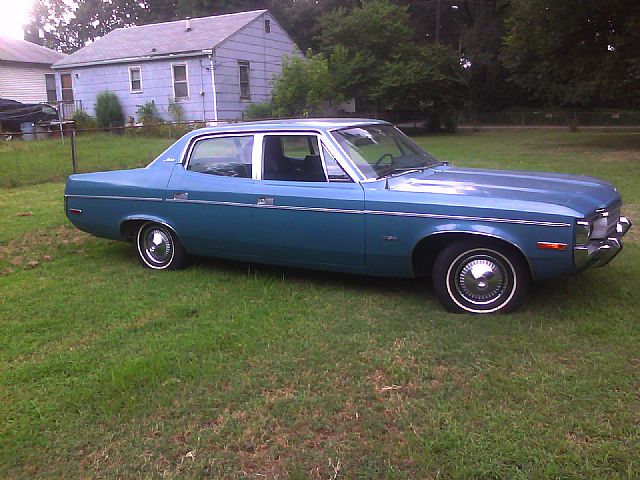
AMC Matador: Mine was Maroon 
I had some money saved up working the hay and in my mom's restaurant. So we set off for town one afternoon, visiting the various used car lots, looking at old pickup trucks and thrashed Pintos. Finally we happened upon a 1971 AMC Matador. It was bone-stock with some melted plastic trim inside from sitting in the hot Eastern Oregon sun. It was big, slow and comfortable. She helped me negotiate the deal and arrange to get it home -- since I was still more than a year away from getting my license.

It was not cool. This was the 1980s and irony had yet to be discovered, but it was a good fit for me.

That car was a freedom machine for me during my teenage years. Before I got my license we practiced on the back roads, piloting the big boat around the curves and along the old highway to horse arena, or to my friend Danny's house.

After I got my license, the Matador was the favorite in school for hauling way too many kids down to the store during lunch our, or over to The Dalles on a Friday night. I got in trouble in that car -- it had a habit of backing into things -- parked cars, a restaurant on my first date -- but I had many more good memories.

It was in that car that I discovered a love of driving. Something I thought about often these past few weeks driving up and down the gorge to be at her bedside. Driving is where I did my thinking, my crying and my grieving. Driving through the beautiful hills and stark vistas, through white capped river and broiling clouds, through shafts of light and heart-stopping sunsets.

My sister Mindy taught me to drive, and so much more.

-30-


Good Fences


My last wood screw went into the last board as the rain began to fall.

There had been a steady drizzle, but now the dark ceiling opened up to a torrential downpour. 

I scrambled to put my tools away, slipping in the mud.  It took me a few moments to realize that it was the very last screw in my pouch - the last 3.25 inch construction screw I had.   It took still longer for me to get inside  the warm house and out of my wet clothes, to stand at the window looking at the green gray fields and admire what I had accomplished.

The fence was finished.

It still needed a coat of white stain on the last section, but that would come on a sunny day. My daughters love painting the white stain.

 I love good fences.

I never thought much about fences until we moved out West in 1978. I was Grace's age then and the forest hills and hidden fields seemed vast open wonderlands to me compared to the crowded suburbs of New Jersey. To be sure, we rambled through the wooded swamplands that backed up to our home there, but it nothing like 82 acres of field and forest. 

There was a great hill overlooking the whole property that we would climb in the last hours of a summer day with the night hawks already diving for prey. It was a grand thing to me then, to stand in an open field on the crest of a high hill, counting the white capped mountains as the pink fire of sunset painted the sky. 

The fences were barbed wire, which tears your shirt if you slide under it, and is too unsteady to climb over. Best to have a friend hold the wire for you,  if you want to climb through. Still they seemed few and far between.  We could ride our horses for miles without touching a road by simply finding the gates between properties, and making sure that we closed each gate we opened behind us. 

I never liked barbed wire. It rips the flesh of spooked horses and his hard to see in the trees. 

The fences I loved were at Crosby Stables. White painted rails around the whole property including the arena where Jim Crosby trained his Tennessee Walkers. I remember the mint green barns and the ink-black Schipperke dogs that Jim and Eunice used to keep. Little Tasmania devil dogs that would run and hop up to land on the rump a moving horse that never lost its stride. Jim was an Iowa man who landed out West with the railroad. We would ride over the hill to his place for 4H sometimes and he gave our family invaluable advice on horses when we were just starting out. Crosby Stables was like a microcosm of a Kentucky estate, four rail white fences cutting serenely through rolling hills. 

It is the fences of his idyll that I have tried to recreate here on my little patch of land. 

When we moved in, 22 years ago. The house was in need of attention more than the property so it became our priority. 

 The borders of the land were blackberry bushes with barbed wire buried somewhere underneath. 

When we had time and energy from our busy low-paying just out of college jobs, I hacked at the blackberries with a machete. Year by year cutting away at the invasive plant's empire of thorns. It was cathartic, but my desk job left me too weak to counter it's ever encroaching vines. It took years -- and eventually Hank's excavator -- to clear the last of it. It opened our property up so we could see the open fields beyond. We put in posts -- some dug with auger on the back of the tractor, other's dug by hand -- until finally the bright white-stained rails emerged. 

Just in time for little girls to clamber over them for walks out in the field. 

You see a good fence does more than just keep livestock in. It keeps animals -- and children -- safe. Lindsay and Grace love climbing the fences, or sitting on them and waving to grandpa as he goes by on the tractor. The white brings bright beauty in the dark gray of winter. 
I ripped out the last of the barbed wire a few weeks ago. 

Dug the post holes by hand. A good post hole digger will beat a week at the gym for building upper body muscles. There was a layer of gravel to go through too and some concrete from the old dairy barn that used to be nearby. At times, I was hands and knees pulling up rocks from the holes. 

Of course I never count right when it comes to how many boards I need, and that means another trip into town. No matter. There was a time when we could only afford to do a few sections of the fence at a time.  

Now I can even afford to buy a store-bought gate and latch. Much better than the home made gates that now want for replacing. 

The girls are helping me paint now that the weather has turned. Lindsay is dreaming of horses that will one day lean their heads over the top rail trying to see if there is a treat in her pocket.

As Lindsay and I paint, I tell her to take a step back every now and then and look at her work.

"Why?" she asks.

"So you can look at how far you've come," I tell her.

 "So you can see how much better you've made it by your hard work."


-30-

Life is Not Fair

Life is not fair.

If you haven't noticed that by now, either you haven't been paying attention or you don't have enough birthdays under your belt.

Life was never fair, and never meant to be.

While whole religions have erupted from the minds of men to address this one issue, the fact remains, there is no divine justice wrought here upon the Earth.

I learned this lesson while I was very young, but had it reinforced by a decade as a newspaper reporter.  I saw cold-blooded killers set free, saw liars triumph and the honest punished for their honesty. Mendacity rules at all levels of power. Inhumanity and incompetence are promoted. Debased actions and bullying are rewarded. Being a reporter is to strive for truth in the face of lies. Journalists comfort the afflicted and afflict the comfortable.

In journalism, fairness is a watchword and justice is what every young wide-eyed new reporter seeks. Yet, the pay is barely minimum wage and you are disposable to your employer and community. After seven years at one paper -- winning awards and working 60 hour weeks, I was told to move on because the corporation didn't want to start paying reporters more than $18,000 a year.

"You've had too many raises," the executive told me from the hollow of his tailored suit. "You've reached the pay ceiling."

Everyone hates you when you tell them the truth anyway.

I had few illusions when I went into nursing.

Sure, there are golden moments when all is right. When your patients are healed by your actions and grateful for your kindness. Those moments must carry your for six months to a year before you might encounter them again. In the interim, the kind nurses will be cursed at and shat upon, denigrated and abused. They will work long hours and then be mandatoried over to work more -- punished for showing up to work.

They will cast themselves upon the rocks of the suffering and pestilent, the addicted and debauched, to be broken, yet to stand again.

At least the pay is better.

Moreover, as emergency room nurses we see the inequality of life's whims on full display. Children suffer, criminals get out of jail by malingering. The drunk driver murders children, then staggers away without a scratch. The kind die in pain and suffering while the cruel survive again and again. Sickness is not tied to sin.  The good die and suffer for no good reason. The gift of survival falls heedless of whether the recipient deserves another breath.

It is a hard lesson for a nurse to learn. The zen of nursing is learning to heal without judging, without a care about justice. Your job is to make the sick better, not to make the world fair.

No, there is no fairness in this business nor in life.

Yet in our larger lives, we must still strive for justice -- for justice is a thing wholly created by humanity. It is our humane reaction to the unfairness of life. Justice is the perfection we seek but may never attain. Striving for justice, fairness and equality are the only tools we have to battle back against the empire of fates that seek to pound us into submission.

The world is not fair.

It never will be.

Unless by our hands we make it so.

-30-


When Should I Start My Midlife Crisis?

I'm not dead yet.

In fact, I'm half 90 this week -- better known as 45 years old.

I think I'm doing pretty good, all things considered.

I have a home, a wife, great kids, a job and motorcycle.

Yet, I'm starting to worry that I'm getting a late start on my mid-life crisis.

Not that I'm planning a whole lot. I already have a motorcycle. I don't drink, smoke or fool around. I got my big career change out of the way a decade ago and I am pretty happy with it.

Maybe I already had it, and just didn't notice.

This birthday has got me wondering what we should consider mid-life these days.

While overall US life expectancy is 78 in this country I am in a position to know that how we live is a major variable. Previous generations have embraced smoking, drugs and alcohol in such a way as to skew the curve such that I often see 90 year olds healthier and stronger than 65 year olds.

That said, according to this calculator from the University of Penn- I'm predicted to live 85 years -- 95 if I'm really, really good and 76 if I take up the habit of driving drunk while not wearing a condom.

However, there is more to life expectancy than risk factors. The Death Clock, which uses a lot fewer factors figures I'll live to 95, but Amy will live to 103! That's the gender penalty. On the other hand, the Social Security Administration is only planning on me living to 81. While another calculator says I'll live to 95.

Or we could all be hit by a bus tomorrow (not all of us by the same bus, of course), making these actuary tables moot - at least on an individual level.

Moreover, we are always underestimating human ingenuity. We are on the verge of some major medical breakthroughs in terms of life expectancy. As aging baby boomers and Google founders pour their riches into ways of living and functioning longer, my guess is that we are going to see a continued increase in the lives of people with few risk factors who take care to lead active, growing lives.

Which brings up the question of the crisis itself. What is a midlife crisis? More than anything it seems to me to be a crisis of expectations - where we come to terms with the fact that we are unlikely to become pro football players or rock stars now that we've reached our 40s.

It is similar to the bad birth experience some mothers find themselves facing after they create elaborate birth plans for the delivery of their baby -- only to discover that baby had different plans about where and how he or she was going to enter the world.

In mid-life, as in birth, it seems we are overwhelmed by what could have, or should have been rather than what we have.

Many of us create ambitious fantasies about our dream life or dream career tangentially tethered -- if at all -- to our real abilities. That "what do you want to be when you grow up" game sticks with us.

Sometimes it becomes the "what do you want to do when you retire" game after a while.

My guess is retirement is likely to be a thing of the past in another 20 years -- so I don't even play that game much anymore.

As Moltke the elder once almost said, "No plan survives first contact with the enemy." If you want to make God laugh, make long range plans. Life intervenes.

Rarely does life go according to our childhood aspirations. Yet these aspirations get integrated into our identity, our dreams - however unrealized - are woven into the fabric of how we think of ourselves. It is that dissonance that causes the crisis in our identity.

I have, at various times had serious plans on being:
  • an astronaut
  • a music producer
  • an engineer/inventor
  • an airline pilot
  • a novelist 
  • a professional football player
  • an Olympic athlete 
Obviously, a couple of those dreams have fallen off the list.

On the other hand, I never had any aspiration to become a journalist - yet I did that for more than a dozen years with mild success. It is a career that I fell into, and it would not let me go.  Nursing was more of a calling than a career choice and the first 10 years dedicated to helping others heal has flown by.

Of course, looking at what we have accomplished and what we have seems to be the psychological salve to sooth this crisis of expectations. We are what we do. When bad things happen, looking at what we learned, or how we grew changes our perception of those events. 

The fact that we have reached the midway point of our existence -- without being hit by a bus -- should be an opportunity to take stock of what we have done, as well as what we have the gumption, ambition and means to still achieve with whatever time is left. 
Unlike our 12 year old selves, we understand now that hard work, dedication, money, talent and dumb luck are all ingredients to achieving anything we set our minds to.

Mostly, dumb luck.

That life hasn't turned out like we planned is often due to the absence of one or multiple ingredients -- or that you were planning on silly things in the first place.

Looking back at my list, I would have missed out on many of the most wonderful things of my life if I had pursued some other course. In his book 59 Seconds, Richard Wiseman talks about creating an attitude of gratitude for what we have -- but ignore -- in our everyday lives. (see the video above)

This exercise is a great for when you are mourning the death of your rock and roll dreams.

Or, whenever you have a birthday.

National Institute on Aging
Calico, Google's Anti-Aging Initiative
Wharton School at University of Penn
59 Seconds: Change Your Life in Under a Minute by Richard Wiseman

Mango in the Melba Toast

I just woke up from a weird dream.

I was working in my mom's old restaurant, The Pancake House. I'm not sure if I was just waiting tables or running the place, when Diedrich Bader came to me with a pained expression on his face. He was obviously some middle manager of some sort and he had a bottle in his hand.

DB: "Did you just talk to a customer about our Melba toast?"

ME "Yeah, somebody asked me about that earlier today."

DB: Did you tell him that we have mango in our melba toast?

ME: I certainly did not. We have mango in the melba toast?

DB:Well, it is mango flavoring and it is what makes our melba toast special and you failed to point this out when the customer asked about it.

ME: I certainly did. I had no idea that there was mango in the melba toast. I've worked here 22 years and this is the first time anyone has even come close to ordering it. In fact, i wonder if that bottle of mango flavoring is 22 years old, I doubt we've ever needed it. Of course, no one put Mango in anything 22 years ago, so it can't possibly be that old.

DB:This is why we are not selling more melba toast.

ME: That and the fact that everything else on the menu tastes an order of magnitude better.

DB:You don't seem to be taking this seriously.

ME: No, I can't possibly take this seriously. But you are for some strange reason. That's kind of troubling to me. You've also taken up an large amount of my time on this discussion. Therefore, I shall have to tender my resignation. Let's consider this my two weeks.

DB:Your resignation?

ME: Yes, clearly I am failing in the melba toast department. By the way, when you call down to payroll for my check, be sure to tell them that I have 16 weeks of vacation piled up, and I'll need to cash that out too. By the end of the day should be fine.

This was a strange dream, but I woke up from it bemused at strangely satisfied. For the record, mom's restaurant never did serve Melba toast -- and we never had middle managers. Moreover, we got along just fine without mango melba toast or middle managers.

The Landing

For the past 22 years, there has always been a room in our house where junk goes to live.

This is an after photo, obviously
It started with our first apartment. The second bedroom holding wedding presents that were far more generous than our poverty-wage accommodations.

When we moved into Dun Elsie, the house was so big, it appeared empty. There were rooms we hardly ever used. But as our family grew and we grew together we expanded to fit the house. Our stuff accumulated and it needed a place to go when it was not being used.

Think of it as a purgatory for items that aren't quite ready for the garage sale, thrift store, basement or dump. 

Many of the rooms in the house have taken their turn - particularly in the early remodeling days when we would move everything out of one room to refinish it. After all that remodeling work, not all the clutter would return, some inevitably would get left behind in one of the out-of-sight rooms.

Over the years, we have come to live in the more of the house, so there are fewer out-of-sight rooms.

Lately, the room in question has been the landing - a square room between the three bedrooms upstairs. The heirloom settee got put up there at Christmas to make room for the Christmas tree and never came back down. We decided we liked having our chairs next to each other by the fire, Amy and I, so we can rock and read books on rainy days. 

Grace's old dresser got put out on the landing there when it was no longer needed. It had been filled with dress-up clothes and princess crowns. She has out-grown these things, it seems. 

Hidden in a corner was our old bed. Bought before the girls came along from guy in Oregon who used to run around England buying up antiques at estate sales, shipping family heirlooms to the states for young childless couples to furnish their homes with. We'd replaced it with a new bed long ago, but its carved legs and hand carved trim was too nice to put down in the basement. 

Yet it was the books that needed the most work. There were three bookshelves overflowing with books. Books sent to me by publishers for review when I was editing Tidepool.org. Books brought home from church. Handyman and how-to books that I culled from thrift stores. I used these old books to teach myself home repair and remodeling. These books marked both our ambitions and our achievements, our dreams and mythology. Gardening books, remodeling books; books purchased at the local library book sale and books lent and given by friends and family. So many books that still want for reading. 

Then there are the other books, well worn and piled in stacks on the corner shelves. These books, kids books, learn to read books. Books, alas, the girls have grown out of. 

Lindsay will be a teenager next week. How is that possible? Here is the Bernstein Bears "Spooky Old Tree" the book we had to read to keep her on the toilet long enough to toilet train her. Here is Danny the Dinosaur -- a book that I read so many times to Grace that I have it memorized. It was the childhood book of my friend Kevin, with his name still in the front. 

WE found my clip books with articles and columns from my years in the newspaper business, as well as a business card from when Amy worked writing for the Cascade Cattleman down in Klamath Falls. 

There were scrapbooks stowed away on a corner shelf. Most are only partly filled with pictures. 

We found old photos of the run-down house we encountered 22 years ago, cold rooms with apartment furniture and broken windows. There were pictures of where I lived and worked in Carlingford, Ireland, and a picture of Amy and I - still just college sweethearts the day before graduation. 

Lindsay has three baby books started, Grace had only a page or two filled out in hers -- not much time for scrapbooking when you have a three year old to chase. I was full time in nursing school when Grace came along, I was gone more often than home back then and Amy had to manage both girls on her own. 

We are sentimental about the books that will never again be read. We sort a pile of Christmas books and save them, for those we turn to year after year. We set aside the ancient books - the children's books passed down from Amy's dad and aunt. Children's books from the 1940s that our children now have grown to love. Tuffy the Tugboat, Uncle Wiggily and my favorite, the surreal masterpiece Mister Dog. There are the books from Amy's childhood - Amy's Long Night and the Little House on the Prairie books. She loved the Laura Ingalls Wilder books so much that she read them aloud to me when we were first married. 

So too, do we set aside those special children's books of our generation that we can't bear to let go. In each of these, between the pages, lies a memory of a moment in Lindsay and Grace's life - a memory we hope they will pass along to their children.  

WE are making a pile for the library book sale, and I have a few nursing textbooks to give away. I've found a friend who wants the old bed that we just don't any place to put. 

Our house was empty once, now it is filled and cozy. The settee, which has been handed down from Amy's grandma, is now cleaned and has a prime position on the landing next to a full -- but neatly organized -- bookshelf.

It is the perfect place to sit, and read a book. 

Best Christmas Movies in the Hunt House

This year, we are replenishing our Christmas movies supply. Not everything is on Netflix and most of our favorites were on VHS tapes and we haven't had a player in years. 

So Amy invested in buying DVDs of her favorites. Some are spendy, some are free for Netflix and for Amazon Prime users and some are just darn hard to find. Here's a list of our eclectic essentials for holiday viewing.

Every Year Mandatory Viewing in the Hunt House:
White Christmas
Christmas in Connecticut
Nightmare Before Christmas
Mickey's Christmas Carol

Christmas in Connecticut - Traditionally, Amy and I sit down to watch this every New Years Eve after the kids are in bed. Curled up on the couch with Amy looking at the tree and watching this black and white postwar classic. Barbara Stanwyck is perfect and the house in the country must have lived in the dreams of many couples creating a new life for each other after the war. The back and forth between Sydney Greenstreet and Cuddles Skall is as evocative of Christmas as gingerbread cookies to me. 

I love these postwar movies. There is a sense of hope for the future, while everyone is making do as best the can. White Christmas falls into this category of course. It is free on Netflix and one of the best Christmas movies of all time - if for no other reason than Bing Crosby singing "White Christmas" twice. So does Miracle on 34th Street, which we don't watch every year. Here too, the theme is adjusting after the war - loss and hope. It goes without saying for this and other movies mentioned, that the remake is no where near as good as the original. 

Holiday Affair, staring Robert Mitchum  and Janet Leigh also deals with Americans coming to grips with loss after the war, while trying to have hope for the future. It's a neat little movie about a war widow and ex-GI with a toy train running through it. Robert Mitchum is one of my favorite actors. 
I'm not a huge It's a Wonderful Life fan, but I do like Jimmy Stewart in The Shop Around the Corner

As for the modern Christmas Movies, here's our list:

Nightmare Before Christmas - not sure if this is a Halloween movie or Christmas movie, but we watch it early and often. It's a movie that is culturally influential far beyond the holidays. We find ourselves singing Danny Elfman's wonderful songs all year 'round. That said, Halloween Town is an acquired taste and not for everybody. 
Love Actually - Some love it, some hate it. It's a grown up movie that doesn't sugar coat the jagged edges of loving relationships, yet is still funny and hopeful. You'll cry, which makes laughing so much better. Not for kids. 
Christmas Vacation - Brutal funny family Christmas classic that you can watch after all the family has gone home and the kids are in bed. 
Mickey's Christmas Carol - Amy's favorite. Expensive on DVD, but worth it. The kids were watching it this morning. 
The Muppet Christmas Carol - My favorite version of the Dickens classic, and one of the best in the Muppet movie cannon. 
Emmit Otter's Jug Band - Speaking of muppets. The girls claim they don't like this movie, but I love it and they watch it with me.
The Santa Clause - Tim Allen is great, which is good because he has to carry the whole movie. This scene in particular gets quoted around the Hunt house all the time.
Scrooged - Bill Murray, Carol Kane, Karen Allen Bobcat and Goldthwait doing a modern TV Executive version of Dickens. Awesome. Think Ghostbuster's Christmas and you get the idea. And Mary Lou Retton
The Polar Express - This movie kind of creeps me out - Uncanny Valley and all that. Let's face it, that's a lot of Tom Hanks. Still the songs and train ride are a blast. This one gets watched a lot on our house. 

Rare Exports - Finnish movie where "the real Santa" is dug up and children start disappearing. I don't think this one is for the kids just yet, but Amy and I loved it. Dark comedy and a lot of suspense. 
Arthur Christmas - originally I had no interest in this movie because I associated it with that weird TV cartoon with the rabbits living in the suburbs that the kids used to watch. It's not. It's English and from the creators of Wallace and Grommit  it's fun and Grand Santa is hilarious. Get and watch it. It's a blast. 
Rise of the Guardians - William Joyce has created THE coolest Santa ever. It's fun, brilliantly animated and designed and just fun to watch. 

TV
Charlie Brown Christmas - Nothing needs to be said here about this, other than I listen to Vince Guaraldi's soundtrack all the time - not just at Christmas. Yet driving over to midnight mass listening to "Christmastime is Here in the snow, with the lights of Astoria is one of my favorite moments on this planet. 
Anything by Rankin and Bass (Rudolf, Little Drummer Boy, The Year Without a Santa Clause and Santa Clause is Coming to Town are my favorites.)
How the Grinch Stole Christmas (not the remake movie. Ick.) 
Santa vs the Snowmen - Weird, crudely animated, still like it. 
Prep and Landing - An Elf gets passed over for a promotion. Doesn't sound like a good plot for a Christmas special, does it? This is clearly one of the best of the recent Christmas TV specials all the same. 

Audio
A Christmas Carol performed by Patrick Stewart. - Dickens' original words are too good to allow the distraction of a movie. Listen instead. Stewart is brilliant. 

These aren't for everyone, and I'm open to suggestions of anything I may have missed. Merry Christmas!

Carrying The Old Woman

Today I was thinking of a variation of an old zen story. 

In the story, two traveling monks reached a river where they met a woman. The woman was wealthy and had porters for her litter, but the porters were afraid to cross the river carrying their mistress. The woman was bitter and cursed the servants. When she saw the two monks, she angrily demanded that they carry her to the other side. 

The young monk hesitated, uneager to help someone who appeared so spiteful, yet the old monk silently picked her up onto his shoulders, transported her across the water, and put her down on the other bank. She did not thank him. Instead she continued to spit venom at the monk, complaining and cursing as he walked away. 
.
As the monks continued on their journey, the young monk was brooding and preoccupied. 

Unable to hold his silence, he spoke out.
"That woman was cruel, and when you helped her, she offered you no gratitude. Instead she cursed you. You should not let her treat you that way."
"Brother," the second monk replied, "I set her down on the other side, while you are still carrying her."

I learned long ago that the way people treat you has little to do with your actions or your value as a human being. Our ego, constantly insists that we deserve respect. So much so, that we think this is the calculation of our worth. 

What I have found in my two careers as a journalist and as a nurse is quite different:

People will yell at you whether you do the right thing or the wrong thing.
People will resent you whether you tell them the truth or a lie.
People will treat you cruelly whether you help them or harm them.

Thus, if their treatment of you is independent of your actions, you should not let their attitude dictate how you proceed in the world. Particularly in nursing, people come into our care with a lifetime of emotional pain that we cannot expect to repair in our short encounter with them. Some live lives so fettered by darkness that they develop antibodies to kindness and light. 

People so often treat the world based on their pain and their ego, not on the human being in front of them. So we should not let their behavior dictate ours. Nor should we take personally the condition of their soul. They may have been broken long before you encountered them and they likely will be broken when you walk away. 

In the meantime, you do what is right, because it is right not because of expected praise or gain. The elder monk did not expect kindness from the rich old woman, nor did he let it bother him. 

We should help, we should be kind, we should tell the truth, we should do the right thing not in some expectation of reward, but rather, because it is the right thing. 

It is OUR actions that define us. Because we are kind, because we are truthful, we do not allow others to germinate unkindness, mendacity or cruelty within us. 

It is easy to allow mistreatment to fester in us, to claw at our awareness such that we do not see everything good around us. Resentment is a handicap to living. 

Ed's Note: The version of this story is from Zen Shorts a book by John J. Muth. The original story referred to a religious prohibition of monks touching women. Muth's version is much more helpful and the book is wonderful. 

Tinker's Lament

If I have one sin
I like to take it apart
Put it back together again
I could buy shiny an new
But I'd rather have rust
and a dent or two

I can't leave it alone
Got to see how it runs
Got to get my fingers dirty
therein lies the fun